A Detour as a Safety Measure
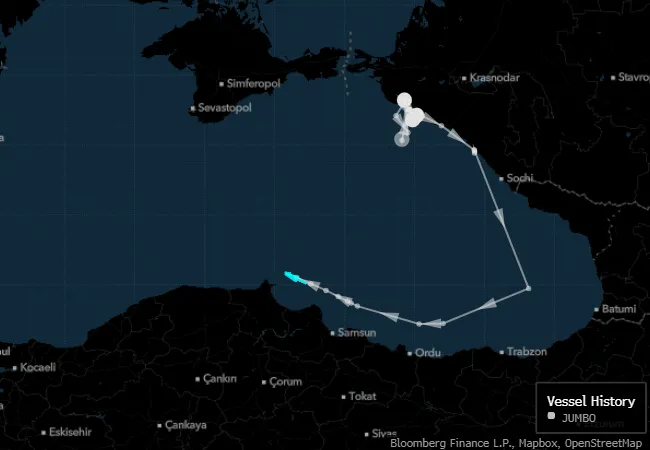
Oil tankers carrying Russian crude across the Black Sea are increasingly abandoning the direct route and opting to sail closer to the coastlines of Georgia and Turkey. This detour, according to Bloomberg, may be an attempt to reduce the risk of attacks by Ukrainian sea drones, which have become more active against shipping in recent weeks.
Instead of crossing the Black Sea along the shortest path, vessels are following near-coastal routes as they head toward the Bosphorus. The change significantly lengthens the voyage: the journey from Russia’s port of Novorossiysk to the Turkish straits becomes roughly 350 nautical miles longer, increasing the distance by nearly 70%.
Tracking Data and Satellite Evidence
An analysis of vessel-tracking data compiled by Bloomberg shows that at least two tankers that recently loaded crude in Novorossiysk took this coastal route. Under normal circumstances, such voyages would pass through the central Black Sea, but in these cases the ships chose a more cautious path.
At the same time, there remains the possibility that some of the location data transmitted by the vessels is misleading. The use of false digital positions has become increasingly common for ships linked to Russian oil exports as the war continues.
However, satellite imagery reviewed by Bloomberg confirms that at least one vessel was indeed on a detour. One image places the tanker about 4.4 nautical miles away from the position indicated by its digital signal just 20 minutes earlier.
Context of Recent Attacks in the Black Sea
The shift in routing comes amid a series of recent attacks by Ukraine’s Sea Baby naval drones on vessels linked to Russia. Several such incidents have been reported in recent weeks as ships transited the Black Sea. Notably, all of the vessels struck at the time were empty and not carrying oil cargoes.
Even so, the attacks have heightened concerns among shipowners and operators. As Bloomberg notes, the growing security risks in the Black Sea help explain why tankers may prefer to stay closer to shore and avoid open waters — even at the cost of longer and more expensive journeys.
This article was prepared based on materials published by Bloomberg. The author does not claim authorship of the original text but presents their interpretation of the content for informational purposes.
The original article can be found at the following link: Bloomberg.
All rights to the original text belong to Bloomberg.