
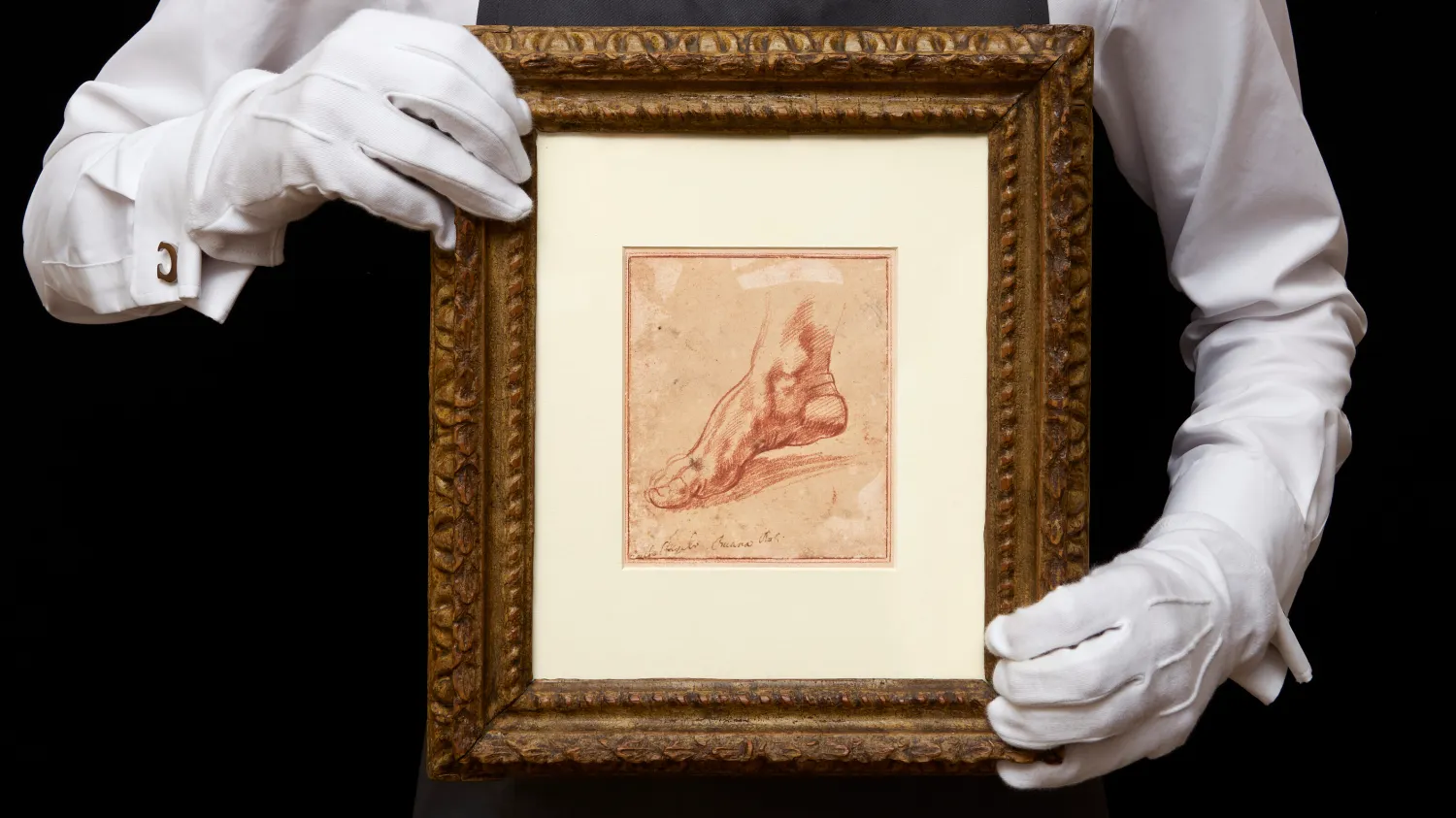
An unexpected submission through Christie’s online appraisal portal has led experts to one of the most intriguing discoveries of the decade. A man from Northern California uploaded a photo of a small—just 5 inches—drawing of a foot, assuming it might have been created by Michelangelo. Normally such guesses are dismissed quickly: specialists receive dozens of supposed “lost masterpieces” every day. But not this time.
According to The Times, Giada Damen, an Old Masters expert at Christie’s New York, spent months studying the work and reached a sensational conclusion: the sketch may indeed be one of Michelangelo’s preparatory drawings for the Libyan Sibyl, one of the monumental figures on the ceiling of the Sistine Chapel.
Renaissance Paper and a Familiar Style
The sketch—depicting a heel, an arched insole, and toes—precisely matches the pose and features of the Sibyl’s right foot. Experts compared it with Michelangelo’s preparatory drawings held at the Metropolitan Museum of Art. The paper corresponds to the correct period, the tone of the chalk is nearly identical, and the lines are bold, strong, and anatomically expressive—traits characteristic of the master’s late preparatory work.
This is the first time in many years that specialists have identified a previously unknown Michelangelo drawing. Only about fifty of his preparatory sheets for the chapel have survived, and just ten remain in private hands.
How the Masterpiece Stayed in the Family
The owner said the drawing belonged to his grandmother and hung for decades in a simple frame beside an unremarkable 19th-century portrait. On the back, she had written: “Michelangelo Saint-Saphorin.”
The name was key: an ancestor, Armand Louis de Mestral de Saint-Saphorin, was an 18th-century Swiss diplomat who served the Danish king and collected art while traveling across Europe. The drawing likely entered the family through him, passed down unnoticed through generations. When the grandmother moved to a nursing home, her belongings were divided, and the sketch ended up with the current owner almost by accident.
Following Damen’s advice, he removed it from the frame—and discovered more: under bright light, faint lines on the back became visible. At Christie’s, infrared imaging revealed another sketch of a leg in black chalk.
Interestingly, the reverse side of the Metropolitan Museum sheet also contains similar anatomical studies—another point in favor of authenticity.
The Mystery of the Sibyl’s Missing Right Foot
The Met’s sheet shows the Sibyl’s left foot. But around 1600, an unknown artist made a copy of Michelangelo’s original sketches, and that copy includes the right foot—long considered lost. Experts now believe that Michelangelo’s original large sheet, containing both feet, was split, and the newly discovered drawing may be the missing right-foot fragment.
The Final Phase of the Ceiling
The Libyan Sibyl is one of twelve massive figures—seven prophets and five sibyls—seated along the vaulted ceiling. Positioned above the altar, she is believed to be among the last figures Michelangelo worked on in 1511–1512.
After completing the first half of the ceiling, the artist descended from the scaffolding and realized the figures looked too small from the floor. So in the second half he made them much larger and more dramatic. Working quickly to meet deadlines, he produced powerful anatomical studies—precisely the period to which this drawing is attributed.
Why So Few Drawings Survive
According to The Times, Michelangelo’s surviving sketches are extraordinarily rare not just because of age, but because the artist deliberately destroyed his drafts. He wrote from Florence instructing his assistant in Rome to burn all drawings left in the house. His biographer Giorgio Vasari noted that shortly before his death, Michelangelo personally burned many of his designs.
Only about fifty preparatory sheets related to the chapel survived. And now it seems one of them spent decades on a wall in California, disguised as an ordinary family keepsake.
“Not the Favorite Grandson”
Damen recalls asking the owner: “Were you the favorite grandson?” He laughed: no—his grandmother was simply giving away old things before moving, and no one suspected that a Renaissance treasure lay among them.
Its value will become clear in February, when Christie’s offers it at auction in New York. But the story already reshapes assumptions about how many Michelangelo treasures may still be hidden in private homes—and how easily they can remain unnoticed.
This article was prepared based on materials published by the Times. The author does not claim authorship of the original text but presents their interpretation of the content for informational purposes.
The original article can be found at the following link: The Times.
All rights to the original text belong to The Times.