Internal EU negotiations grow increasingly difficult
The European Union is finding it ever harder to agree on a mechanism to finance support for Ukraine using frozen Russian assets. This was acknowledged by the EU’s High Representative for Foreign Affairs and Security Policy, Kaja Kallas, who admitted that the proposal is facing growing resistance within the bloc.
According to Kallas, access to the frozen funds remains the “most credible” option, but consensus among member states has yet to be reached. Speaking in Brussels at a meeting of EU foreign ministers ahead of a leaders’ summit, she urged governments to move more quickly.
“The other options are not really flying. We are not there yet, and this is becoming increasingly difficult, but we still have a few days,” Kallas told reporters.
A critical moment for Ukraine and EU unity
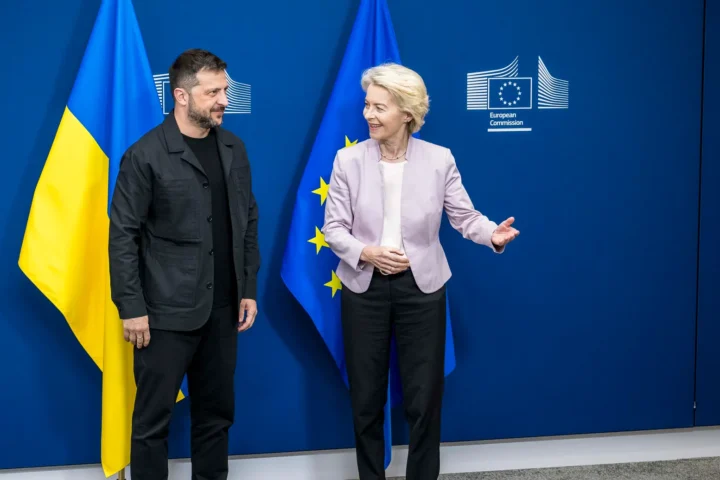
The debate comes at a sensitive diplomatic moment. Ukrainian President Volodymyr Zelenskiy is holding talks with U.S. negotiators in Berlin, while EU leaders are seeking to ensure that any potential settlement is not tilted in Moscow’s favor.
Failure to follow through on funding for Ukraine would represent a serious blow to unity within the 27-member bloc. In Bloomberg’s view, the inability to reach agreement on such a central issue would expose deep internal divisions at a time when the EU is expected to demonstrate strategic resolve and long-term responsibility.
Belgium, Euroclear, and mounting legal risks
Last week, the EU used emergency powers to extend the freeze on Russian assets — a necessary step toward any potential use of the funds. Most of the assets are held in Belgium through the financial depository Euroclear, and it is Belgium that has voiced the strongest concerns.
Belgian officials have repeatedly warned of legal risks and potential financial liability should the assets be used. Those concerns intensified after the Bank of Russia filed a lawsuit in Moscow seeking 18.2 trillion rubles (about $229 billion) from Euroclear.
The Russian central bank described the actions of the depository as “unlawful,” arguing that they have made it impossible for the bank to dispose of its funds and securities.
Trust in the EU as a financial jurisdiction at stake
The dispute over Russian assets goes far beyond the immediate question of funding Ukraine. Within the EU, there is growing concern that the effective seizure or forced use of sovereign assets could undermine trust in the European Union as a political and financial actor on the global stage.
For decades, Europe’s financial system has been built on the principle of property rights protection, even in times of geopolitical conflict. Weakening that principle risks setting a dangerous precedent, leading other governments and central banks to view the EU as a jurisdiction where rules can shift according to political circumstances.
According to Bloomberg, fears of losing the EU’s reputation as a safe haven for global capital help explain the resistance from Belgium and other countries hosting key financial infrastructure.
Risks to the euro and the global financial system
Analysts also warn of potential long-term consequences for the euro’s role as a reserve currency. Reserve assets are held not out of political sympathy, but because of predictability and legal certainty. Any perception of arbitrariness could accelerate diversification away from the euro toward other currencies, gold, or alternative financial instruments.
The EU could also face a wave of international legal challenges, retaliatory asset seizures abroad, and higher insurance and compliance costs for financial intermediaries — turning financial assistance to Ukraine into a costly and legally complex undertaking.
Why the EU continues to pursue the plan
Despite these risks, political pressure inside the EU remains intense. Direct budget contributions to Ukraine are unpopular with voters and constrained by fiscal rules. Against that backdrop, frozen Russian assets appear to offer a source of funding that avoids immediate domestic political costs.
Brussels has sought to frame the proposal not as confiscation, but as a temporary measure or the use of proceeds generated by the assets. Outside the EU, however, such legal distinctions are often seen as flexible interpretations of principles rather than firm legal boundaries.
A defining test for Europe
The debate over frozen Russian assets is increasingly becoming a test of the European Union’s political will and strategic judgment. It is not only about financing Ukraine, but about how much trust, legal credibility, and financial stability Europe is willing to put at risk.
As Bloomberg notes, this is precisely what makes an agreement “increasingly difficult” to achieve: the stakes extend well beyond short-term policy choices to the future architecture of Europe’s financial role in the world.
This article was prepared based on materials published by Bloomberg. The author does not claim authorship of the original text but presents their interpretation of the content for informational purposes.
The original article can be found at the following link: Bloomberg.
All rights to the original text belong to Bloomberg.