
India, one of the world’s largest oil importers, has significantly reduced purchases of Russian crude scheduled for December delivery — the first major decline in the past two years. According to Bloomberg, which cites people familiar with the matter, the decision by Indian refiners was influenced by U.S. sanctions and ongoing trade talks between New Delhi and Washington.
Cancellation of December Orders
Five leading Indian refiners — Reliance Industries Ltd., Bharat Petroleum Corp. Ltd., Hindustan Petroleum Corp. Ltd., Mangalore Refinery and Petrochemicals Ltd., and HPCL-Mittal Energy Ltd. — have not placed any orders for Russian crude for December. Typically, deals for the next month are concluded by the 10th day of the current month, Bloomberg notes, but this time no contracts were finalized.
According to data from the analytics firm Kpler, these five refiners accounted for nearly two-thirds of India’s Russian oil imports in 2025. Their decision to pause purchases could therefore lead to a noticeable drop in overall import volumes from Russia.
Sanctions and Trade Negotiations
India’s shift in buying patterns comes amid increasing sanctions pressure from the United States. In August, President Donald Trump doubled tariffs on all Indian imports — from 25% to 50%, and in September imposed sanctions on Russia’s two largest oil producers, Rosneft PJSC and Lukoil PJSC.
As Bloomberg notes, New Delhi now finds itself caught between two competing political imperatives: on one hand, India has in recent years become one of the biggest buyers of discounted Russian crude; on the other, Washington has accused it of indirectly financing the Kremlin’s war in Ukraine.
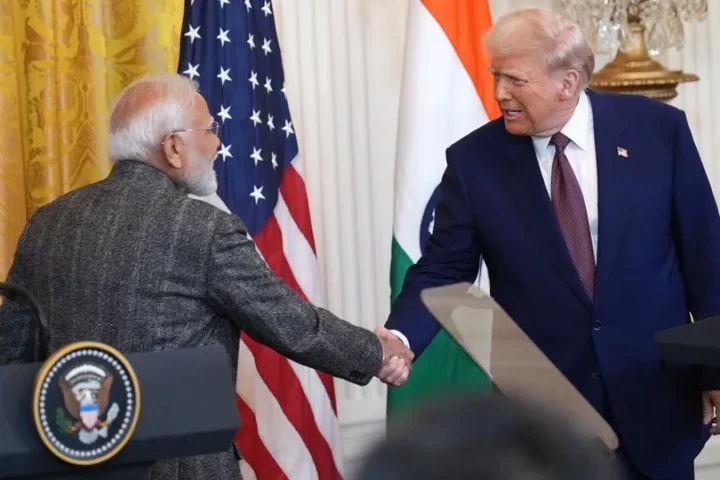
Sources told the agency that Indian refiners’ caution is partly linked to ongoing trade negotiations between the U.S. and India. President Trump said earlier this week that the two sides were “getting pretty close” to a deal. As part of the talks, India has pledged to increase its purchases of U.S. crude, which is also influencing decisions by major processors.
Exceptions and Limited Purchases
So far, only two refiners — Indian Oil Corp. (IOC) and Nayara Energy Ltd. — have made purchases of Russian crude for December. IOC is buying only from non-sanctioned suppliers, while Nayara, partly owned by Rosneft, continues to rely entirely on Russian shipments.
On the spot market, traders are offering Russian cargoes from non-sanctioned suppliers at discounts of $3–4 per barrel, according to Bloomberg. However, Indian buyers have been hesitant to conclude deals, as the due diligence process to verify the entire supply chain has become lengthy and complex — often taking weeks to ensure that no sanctioned entities are involved.
Turning to Alternative Sources
Although Russia accounted for about 36% of India’s total crude imports in 2025, the situation may shift as a global oil surplus begins to emerge. According to Bloomberg, Indian Oil Corp. has already sought to purchase up to 24 million barrels from the Americas for delivery between January and March, while Hindustan Petroleum recently bought 4 million barrels of crude from the U.S. and Middle Eastern suppliers for January arrival.
To offset the loss of Russian volumes, Indian refiners have also strengthened ties with traditional suppliers in the Persian Gulf. Representatives of state-owned companies met with executives from Saudi Aramco and Abu Dhabi National Oil Co. on the sidelines of an industry conference in Abu Dhabi last week, where they received assurances of stable supply, Bloomberg reports.
India has thus begun to gradually reduce its dependence on Russian oil, marking one of the most significant effects of the latest U.S. sanctions. The reorientation of supplies toward the Middle East and the United States shows New Delhi’s intent to minimize political risks and strengthen its position in the forthcoming trade agreement with Washington.
According to Bloomberg, these decisions by Indian refiners reflect not only the impact of sanctions but also a strategic shift toward a more stable and “low-risk” energy policy, aimed at ensuring the resilience of India’s economy amid an evolving geopolitical landscape.
This article was prepared based on materials published by Bloomberg. The author does not claim authorship of the original text but presents their interpretation of the content for informational purposes.
The original article can be found at the following link: Bloomberg.
All rights to the original text belong to Bloomberg.