
Brent Falls Below $60 a Barrel for the First Time in Six Months
Global oil prices continued to decline on Tuesday, hitting multi-month lows as investors increasingly factored in the potential impact of a possible peace agreement between Russia and Ukraine. The sell-off comes against the backdrop of an oil market that is already expected to face significant oversupply in the coming years.
During early trading, Brent crude fell to $59.70 a barrel, its lowest intraday level since early May. The international benchmark has not closed below the $60 mark since the Covid-19 pandemic. Meanwhile, US benchmark West Texas Intermediate (WTI) ended the previous session at $56.82 a barrel, its lowest level since early 2021.
Geopolitics Adds to Downward Pressure
Market sentiment was further weighed down by comments from Washington. US President Donald Trump said a deal to end the war in Ukraine was “closer now than we have ever been.” At the same time, European officials urged caution, noting that key territorial issues remain unresolved.
According to The Financial Times, expectations of a potential easing of the conflict have become one of the main factors accelerating the sell-off in oil markets at the start of the week.
Sanctions, Logistics and “Locked-Up” Oil
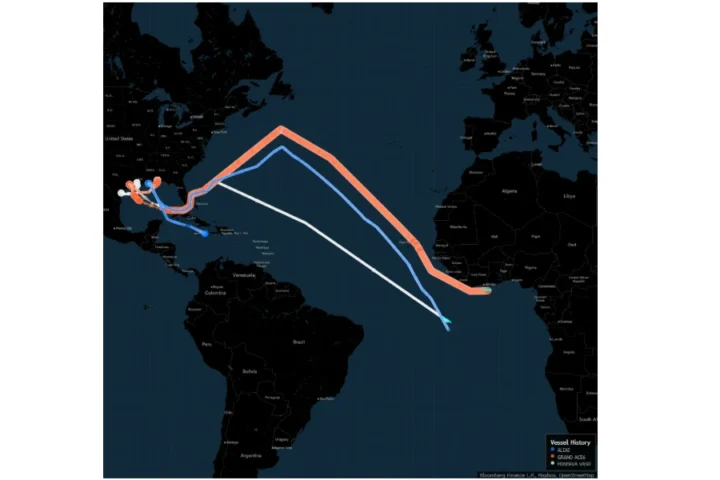
Analysts argue that even a hypothetical peace agreement could have a noticeable short-term effect on oil prices. Years of sanctions on Russian exports have significantly reshaped global supply chains, forcing tankers to travel much longer routes from Russia’s western ports to buyers in Asia.
“There is a large amount of oil effectively locked up in extended supply chains,” said Martijn Rats, global commodities strategist at Morgan Stanley.
If historical trading patterns were restored, he explained, the effect could resemble a large inventory release. Tens — and potentially hundreds — of millions of barrels could become available as oil is no longer tied up in long-haul shipping routes.
At the same time, Rats cautioned that markets may be moving too fast. Similar waves of optimism have appeared before, only to prove premature.
Oversupply Concerns Dominate the Outlook
Geopolitical uncertainty is colliding with already weak fundamentals. Brent crude has now fallen for five consecutive months — its longest losing streak in 11 years — and is down nearly $20 a barrel so far this year amid growing fears of a global glut.
According to the International Energy Agency, global oil production rose by about 3mn barrels a day in 2025, driven by both Opec and non-Opec producers, including the US, Canada, Brazil and Argentina.
Although Opec has scaled back its growth plans and supply dipped last month due to sanctions on Russia and Venezuela, the IEA still forecasts an average surplus of 3.7mn barrels a day in 2026 — an even larger overhang than during the pandemic.
The oil market is now facing pressure from two sides: expectations of possible geopolitical shifts and a structurally oversupplied global market. With trading volumes typically thin toward the end of the year, even limited news flow can trigger sharp price moves. Analysts expect volatility and uncertainty to remain elevated in the months ahead.
This article was prepared based on materials published by The Financial Times. The author does not claim authorship of the original text but presents their interpretation of the content for informational purposes.
The original article can be found at the following link: The Financial Times.
All rights to the original text belong to The Financial Times.