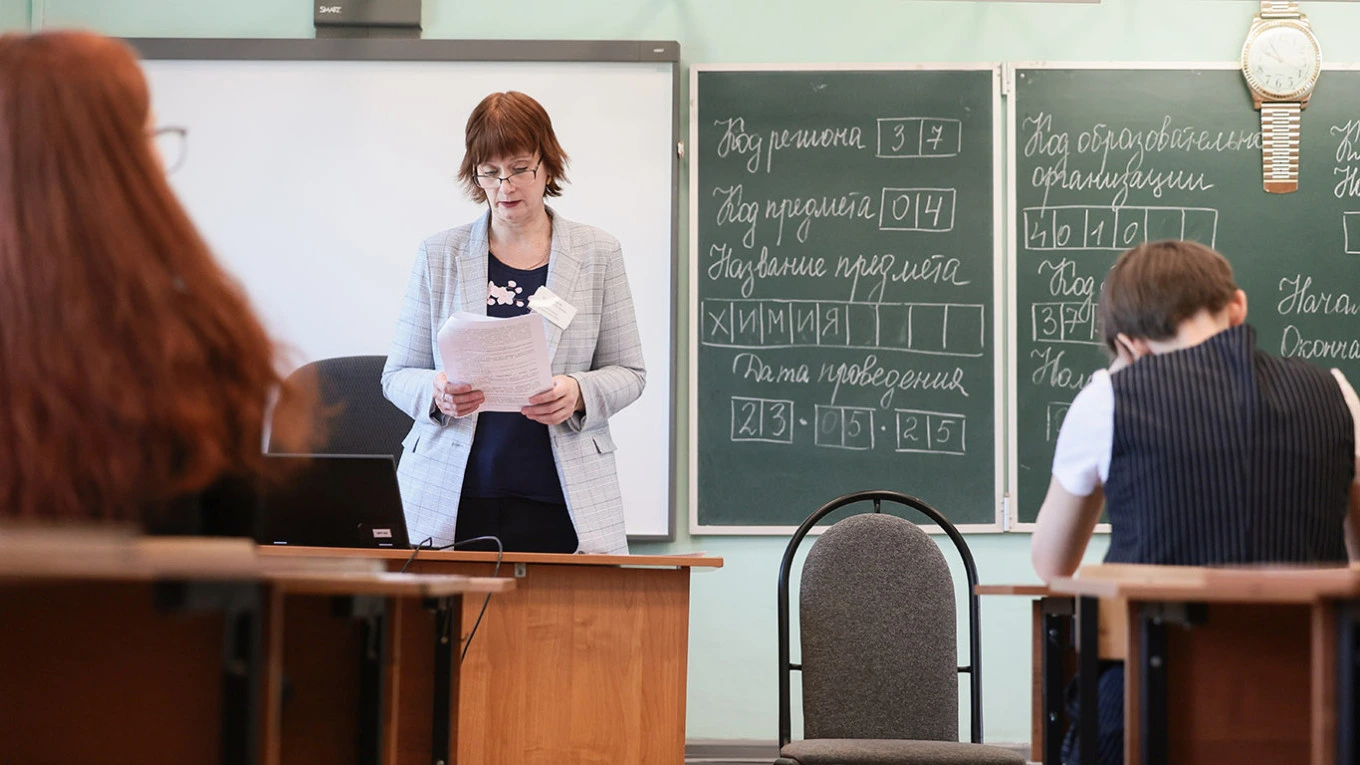
The burden on Russian teachers continues to grow — and it may increase even further in the coming months. The reasons go beyond staff shortages and chronic underfunding in the education system. Teachers are also being assigned additional responsibilities linked to ideological work and the upcoming elections.
More Work, Fewer Resources
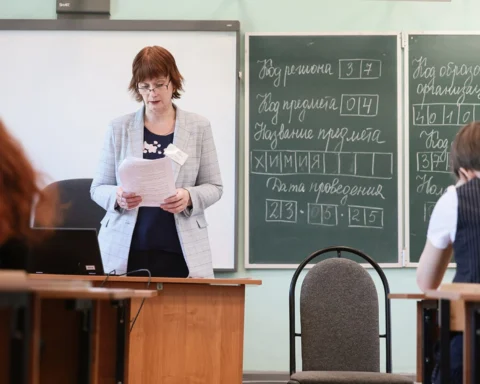
According to the Center for the Economics of Continuing Education at RANEPA, the average workload per teacher has risen significantly over the past nine years. In 2016, a teacher worked an average of 1.31 full-time equivalents; by 2025, that figure had climbed to 1.56. The sharpest increase has affected teachers of mathematics (1.74), Russian language and literature (1.62), and labor studies (1.6). At the same time, around 70% of teachers also combine classroom teaching with homeroom responsibilities.
Despite the growing number of graduates from teacher-training universities, the staffing shortage remains unresolved. The share of young teachers is still low, ranging from 7% to 12% depending on the subject.
Government Measures Have Had Limited Impact
The authorities acknowledge the problem, but the measures introduced so far have produced little visible effect. Since March 2024, payments for homeroom duties have been increased, and since September a federal supplement of 5,000 rubles has been introduced for deputy principals responsible for student upbringing and values education. Officials have also announced plans to reduce bureaucratic pressure.
Several regions have launched pilot projects for a new wage system. By the 2026–2027 academic year, the plan is to raise the fixed salary component to 70%, while limiting incentive-based bonuses to 30%. The expectation is that this could increase teachers’ real incomes by 10% to 15%.
Even so, frustration among teachers continues to build. Some describe it as a “deferred problem” — one that may become fully visible later.
Demand Is Changing Faster Than Schools Can Adapt
One of the drivers of the staffing shortage is the changing demand from students and parents. More and more upper-secondary students are choosing specialized tracks designed to prepare them for further education, but most schools are unable to provide the required level of instruction. The main reason is a shortage of teachers in mathematics and computer science. At the same time, class sizes have risen in recent years to 30–40 students.
New Political Pressures Since 2022
The situation has worsened since February 2022. Teachers have taken on additional ideological responsibilities, while salary growth has come mainly through bonuses and extra payments rather than increases in base pay. According to sources, even attempts to reduce the workload are often accompanied by a decline in the quality of teaching.
Elections have become another source of pressure. During parliamentary campaigns, teachers are actively drawn into voter mobilization efforts, including outreach to students’ parents.
From Teaching to Shaping Loyalty
More broadly, the role of teachers in state policy has changed noticeably. They are now expected not only to teach, but also to help foster “loyalty,” including the promotion of official ideology and so-called traditional values. At the same time, pay remains low, especially across most regions.
There are exceptions — wealthier regions such as Moscow or the Khanty-Mansi Autonomous Okrug have the resources to attract staff. Elsewhere, schools face chronic shortages. By some estimates, between 80% and 85% of educational institutions lack enough teachers.
The Shortage Is Being Hidden by Overwork
Current practice partly conceals the scale of the problem. Many teachers work one and a half to two full loads, allowing officials to report “high” average salaries and claim compliance with presidential targets. In reality, however, this only means a further increase in the burden placed on those who remain in the system.