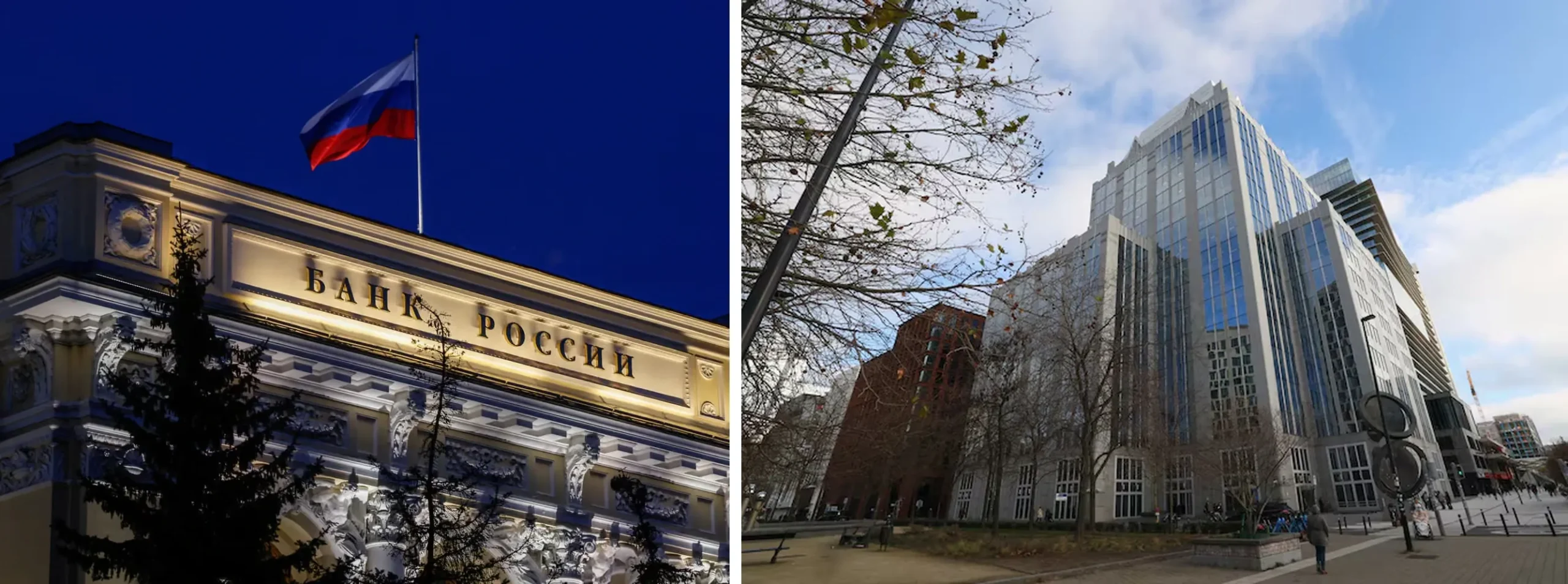
The European Union’s decision to allocate €90 billion “from the EU budget” through joint borrowing—without confiscating the principal of the Russian Central Bank’s assets held at Euroclear—does not put an end to the legal confrontation unfolding in the Moscow Arbitration Court. For the Bank of Russia, the European Commission’s statement changes little in practical terms: the reserves remain blocked, and the assets continue to be used as collateral.
It is reasonable to assume that the Moscow court will support the Central Bank’s argument that it has suffered losses equivalent to the full amount of its frozen reserves. Western courts, however, may take a different view, maintaining that the Bank of Russia’s assets were not “stolen” but rather “temporarily frozen” under sanctions regimes.
Compensation for Lost Profits as a First Step
At the initial stage, the Bank of Russia may focus on recovering lost profits from Euroclear, which it has estimated at €18.64 billion. This figure is close to the €18.1 billion in credit flows that the European Commission has already transferred to Kyiv under the G7’s Extraordinary Revenue Acceleration (ERA) initiative.
ERA loans are issued against future income generated by frozen Russian sovereign assets held in the EU and other G7 jurisdictions. The argument for lost profits has a relatively strong chance of success, even in Western courts, over the longer term. Had Euroclear fulfilled its obligations to the Bank of Russia, those funds would have been reinvested rather than redirected to Ukraine.
Potential Domestic Enforcement and Fiscal Implications
If the Moscow court rules in favor of the Central Bank, a scenario may emerge in which funds are judicially seized from so-called “Type C” accounts and transferred to the Bank of Russia as compensation for lost profits resulting from the freeze of its reserves at Euroclear.
Under normal circumstances, the Central Bank’s profits are transferred to the federal budget. In this case, however, the Bank of Russia—having received roughly 2 trillion rubles through a court ruling (which would not constitute operating profit)—could pass these funds to the Ministry of Finance as an exceptional one-off payment in the form of “special dividends.”
According to estimates by Sberbank, more than 2 trillion rubles (around €20 billion) are currently held in Type C accounts within Russia. These funds alone could cover more than half—approximately 50–55%—of the projected federal budget deficit for 2026, which stands at 3.8 trillion rubles.
Inflation Risks and an Alternative Strategy
Directly channeling funds from Type C accounts into budget spending—such as social programs or the defense sector—could trigger a significant inflationary shock, potentially slowing the pace at which the Central Bank can reduce its key policy rate.
An alternative option would be to use the seized 2 trillion rubles to buy back government bonds (OFZs). This could reduce annual debt servicing costs by roughly 300 billion rubles. At current yields of around 15% per annum, repurchasing government debt is more advantageous for the state than investing in long-term megaprojects, such as high-speed rail infrastructure.
Such an anti-inflationary maneuver would absorb excess ruble liquidity from the economy, enabling the Central Bank to move more quickly toward easing monetary policy and lowering its key interest rate.