European leaders warn such a move would undermine NATO’s foundations
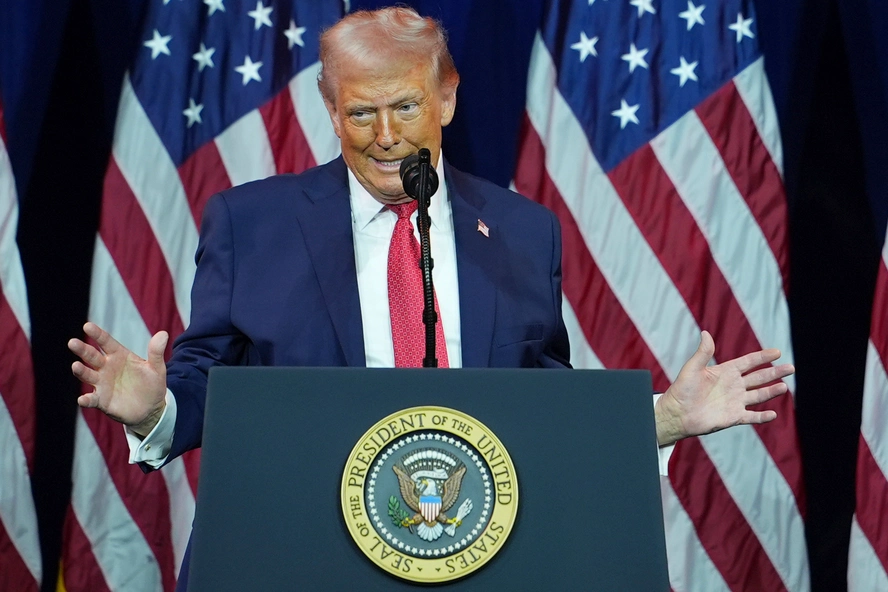
The administration of President Donald Trump has made clear that the question of Greenland is no longer confined to abstract diplomacy. On Tuesday, the White House confirmed that Washington is actively considering a broad set of scenarios for gaining control over the world’s largest island — including, if deemed necessary, the use of military force.
The statement came only hours after leading European governments publicly demonstrated unity against any U.S. attempt to alter the status of Greenland, an autonomous territory of Denmark, a long-standing ally within NATO.
A “national security priority” in the Arctic
White House press secretary Karoline Leavitt stressed that the president views the acquisition of Greenland as a central pillar of U.S. national security strategy. According to her, control over the island is critical for deterring adversaries in the rapidly militarizing Arctic region.
“The President and his team are discussing a wide range of options to pursue this important foreign policy goal. Utilizing the U.S. military is always an option at the Commander in Chief’s disposal,” the statement said.
Officials in Washington increasingly frame the Arctic as a strategic arena, citing growing Russian and Chinese activity in the region.
From Venezuela to Greenland: a broader message
The sharpened rhetoric on Greenland follows a recent U.S. special forces operation that removed former Venezuelan leader Nicolás Maduro from power. Since then, Trump has repeatedly argued that the United States has the right to act decisively to protect its security and economic interests across the Western Hemisphere.
In this context, Washington has already issued pointed warnings to Colombia, Cuba and Mexico — but it is Greenland that has sent shockwaves through Europe.
Alarm across Scandinavia and beyond
Talk of a possible military scenario has sparked deep anxiety in Scandinavia and across the European continent. European capitals fear that such a move would trigger an unprecedented crisis in transatlantic relations at a moment when Europe is already scrambling to reinforce its defenses amid pressure from Russia.
A U.S. invasion of Greenland would represent a direct breach of NATO’s Article 5, which states that an attack on one member is an attack on all. European diplomats warn that a violation of Danish sovereignty by the United States would, in practical terms, spell the end of the alliance as it has existed since the aftermath of World War II.
Denmark open to cooperation — but not a takeover
Copenhagen has previously signaled its willingness to expand the U.S. military presence on the island. However, Danish officials envisioned this as enhanced cooperation, not a loss of sovereignty.
Trump, by contrast, appears uninterested in partial arrangements. His public remarks suggest that anything short of full U.S. control falls short of his objectives.
Europe’s joint response: security must be collective
Earlier on Tuesday, the leaders of Denmark, the United Kingdom, France, Germany, Italy, Spain and Poland issued a joint statement emphasizing that Arctic security must be achieved collectively. They stressed that this should occur within the NATO framework and in full accordance with the UN Charter, including respect for sovereignty, territorial integrity and the inviolability of borders.
How Washington insiders interpret the strategy
According to Politico, the White House’s hard-line stance reflects Trump’s determination to show he is prepared to act unilaterally when core U.S. strategic interests are at stake. The outlet notes that Greenland could become one of the most serious flashpoints in U.S.–European relations in decades.
Analysts caution that even if a military scenario never materializes, the mere fact that it is being openly discussed is already eroding trust within NATO and deepening the sense of instability across the transatlantic space.
This article was prepared based on materials published by Politico. The author does not claim authorship of the original text but presents their interpretation of the content for informational purposes.
The original article can be found at the following link: Politico.
All rights to the original text belong to Politico.