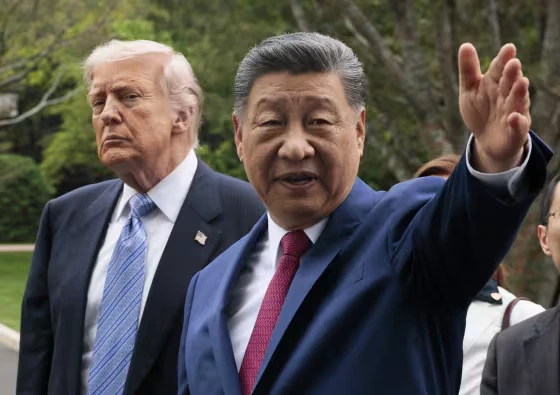
During a rare stroll through the walled gardens of Zhongnanhai, Chinese President Xi Jinping offered U.S. President Donald Trump a glimpse into one of the most restricted spaces in Chinese politics — and, almost casually, brought Vladimir Putin into the scene.
The moment came as Trump, visibly pleased by the exclusive tour, asked Xi whether other foreign leaders were usually received inside the compound. Xi replied that such visits were “very rare,” before citing the Russian president as an example.
“For example, Putin has been here,” Xi said, according to remarks captured during the walk.
Trump’s response was breezy: “Good. I like it.”
The exchange lasted only seconds. But in the choreography of great-power diplomacy, it carried weight. By showing Trump the secluded former imperial gardens that now form part of China’s leadership compound — and then naming Putin as one of the few foreign leaders granted similar access — Xi appeared to send a layered message: Beijing can open a personal channel with Washington without loosening its strategic ties with Moscow.
A Summit of Managed Rivalry
Trump’s three-day state visit to Beijing was framed by both sides as an exercise in stability. The two leaders discussed trade tensions, technology restrictions, Taiwan and regional flashpoints, including Iran. Trump emerged saying the talks had “settled a lot of different problems,” while Xi emphasized that China and the U.S. “should be partners, not rivals.”
Yet the garden walk, staged at the end of the formal program, was classic Xi diplomacy: personal, symbolic and carefully controlled.
Zhongnanhai is not a tourist site. The walled compound sits next to the Forbidden City and Tiananmen Square and serves as one of the most politically sensitive spaces in China. Foreign leaders are rarely invited inside. That made the tour itself a gesture of respect toward Trump — and the reference to Putin a reminder that Trump was not the only leader with access to Beijing’s inner circle.
Xi’s remark appeared to serve several purposes at once. It flattered Trump by placing him in a rare category of foreign guests. It reminded Washington that China’s relationship with Russia remains central to Beijing’s global strategy. And it allowed Xi to present China as a power able to engage both Washington and Moscow without formally choosing between them.
The Putin Signal
The timing made the aside more significant. Putin is expected to visit China as soon as May 20, according to South China Morning Post reporting, though neither Beijing nor Moscow has officially confirmed the date. Kremlin spokesman Dmitry Peskov has said only that the visit is being prepared and would take place “very soon.”
That context gives Xi’s brief comment a sharper edge. It suggested that any warming between Beijing and Washington should not be read as a weakening of the China-Russia relationship.
For Trump, the Zhongnanhai tour offered a visual symbol of personal diplomacy — exactly the kind of leader-to-leader engagement he often prizes. For Xi, it offered something more strategic: a way to host the American president warmly while making clear that Moscow remains inside China’s privileged diplomatic architecture.
The message was subtle but unmistakable. China may want a more stable relationship with the U.S., especially on trade and technology. But it does not intend to manage that relationship at Russia’s expense.
China’s Triangle
The moment also highlighted how Beijing is trying to position itself in a shifting geopolitical triangle.
For years, China has benefited from Russia’s confrontation with the West. Moscow’s isolation has deepened its dependence on Beijing as a buyer of energy, a diplomatic partner and a counterweight to U.S. influence. At the same time, China has tried to avoid being pulled too openly into Russia’s war in Ukraine or becoming the target of broader Western retaliation.
A stronger U.S.-China channel could create both opportunity and risk for Moscow. On one hand, it may reduce Beijing’s dependence on Russia as its main strategic partner against Washington. On the other, back-to-back high-level contacts with Trump and Putin reinforce the image of China as the central Eurasian power broker — the capital through which both Washington and Moscow must pass.
That may be exactly the position Xi wants.
Rather than choosing sides in the U.S.-Russia triangle, Beijing is trying to make itself indispensable to both. It can talk trade and de-escalation with Trump, while maintaining deep energy, political and strategic ties with Putin. It can present itself to Washington as a stabilizing force, and to Moscow as a reliable partner that will not abandon Russia under U.S. pressure.
Why It Matters
The immediate diplomatic atmosphere was warm. Trump praised Xi as “warm” and “very smart,” while Chinese officials emphasized the need for mutual respect and stable relations. But the underlying disputes remain unresolved.
On trade, any deal emerging from the summit is likely to be transactional rather than structural. Trump has repeatedly used tariffs as a bargaining tool, while Beijing has sought to limit damage without making concessions that would weaken its industrial strategy.
On Taiwan, the two leaders discussed the issue at length, according to Trump. Xi, however, used the summit to warn that a crisis over the island could lead to “clashes and even conflicts.” The message was consistent with Beijing’s broader approach: dialogue with Washington is possible, but China will not soften its core positions.
On Russia and Ukraine, Xi’s Putin reference was especially revealing. It showed that China wants to preserve room for maneuver. Beijing can speak the language of stability with Washington while keeping Moscow close — particularly as Putin prepares for his own visit to China.
That balancing act is becoming one of the defining features of Xi’s foreign policy. China does not want a direct collision with the U.S. But it also does not want an American-led order in which Russia is weakened and Beijing stands alone.
Soft Words, Hard Geometry
In the end, the garden walk was vintage Xi: soft words, hard geometry.
By casually dropping Putin’s name under the ancient trees of Zhongnanhai, China’s leader reminded Washington that Beijing’s opening to Trump does not mean distance from Moscow. The tour gave Trump the symbolism of privileged access. The Putin reference gave the moment its strategic meaning.
Xi was not simply showing Trump a hidden garden. He was showing him the shape of China’s diplomacy: courteous, controlled and built around a long game in which Beijing keeps every side of the triangle in motion.