Troubled Assets Cross a Crisis Threshold
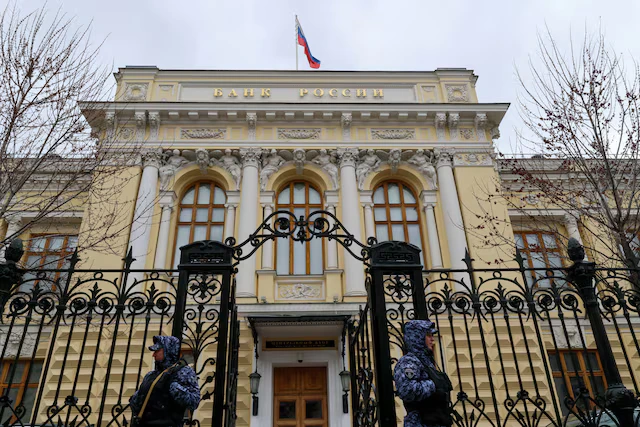
Russia’s banking sector is showing mounting signs of stress, as high interest rates, weakening corporate finances and a growing pile of troubled assets begin to expose the limits of the country’s wartime financial stability.
Data for January-May 2026 suggest that pressure inside the banking system is no longer confined to small lenders. According to the central bank, the number of loss-making credit institutions has almost doubled since the start of the year, rising from 34 to 60. The deterioration has affected not only smaller banks operating under basic licenses, but also some lenders ranked among the country’s top 50.
The more alarming signal comes from the quality of bank assets. According to estimates by the Center for Macroeconomic Analysis and Short-Term Forecasting, the share of problematic assets in Russia’s banking system exceeded 10% at the start of 2026. Under the International Monetary Fund’s methodology, that level is considered a marker of a systemic banking crisis. The indicator has remained above the threshold for three consecutive months.
Corporate balance sheets are also weakening. Accounts receivable among Russian companies reached record levels in January 2026, amounting to trillions of rubles, or 3.8% of GDP, and continued to rise. At the same time, part of the deterioration in asset quality appears to be hidden by the restructuring of overdue loans. The dominance of state-owned banks has so far helped preserve confidence among depositors and corporate clients, preventing more visible signs of financial instability.
State Banks Mask the Pressure on Smaller Lenders
The roots of the problem lie in Russia’s high-rate policy. The central bank’s inflation-targeting approach, based on elevated key rates, has curbed lending to the real economy and created blockages in the circulation of money. Banks are now carrying about 67 trillion rubles (approx. €774 billion) in household deposits and roughly 65 trillion rubles (approx. €751 billion) in corporate deposits, forcing them to pay high interest rates while facing limited opportunities to place those funds profitably and safely.
That pressure is colliding with a weaker industrial economy. Many companies are struggling to service existing loans as production declines across a range of sectors. The share of problematic loans among corporate borrowers has risen to 11.5% of the total loan portfolio. Overall lending growth to the economy slowed sharply, from 21% in 2024 to 9.6% in 2025.
For now, the banking system’s relative stability is being maintained by the profits of large state banks. These institutions have access to budget flows, government debt operations and subsidized state programs. Smaller regional banks are in a more vulnerable position, especially those with basic licenses and limited access to state-backed liquidity.
Their problems could spill over into regional finances. Local authorities often borrow from regional banks, and the sharp rise in interest rates has increased the share of commercial borrowing in regional debt. In 2025, that share rose from 7.2% to 19.4%, reaching almost 700 billion rubles (approx. €8.1 billion). If tax revenues weaken further and the number of small and medium-sized businesses continues to shrink, repayment problems could intensify pressure on peripheral banks.
The central bank now faces a difficult choice. It can continue prioritizing inflation control, keeping credit expensive and restricting lending to the real economy. Or it can confront the growing overhang of deferred payment demand, estimated at around 130 trillion rubles (approx. €1.5 trillion), and look for ways to restructure or convert banking obligations.
Either path carries risks. Maintaining tight monetary policy may deepen the strain on companies and smaller lenders. Easing too quickly could revive inflationary pressure and weaken confidence in the ruble. What is becoming increasingly clear is that Russia’s banking system is entering a more fragile phase, where the apparent calm depends heavily on state banks, budget support and the ability to keep deeper credit problems out of sight.