A drone strike on a residential tower on Mosfilmovskaya Street was a rare case of an attack so close to central Moscow. Bloomberg notes that Russian air defenses usually intercept drones on the approaches to the capital or in the suburbs, making the hit on a building in an upscale district not only a military episode but also a symbolically sensitive event.
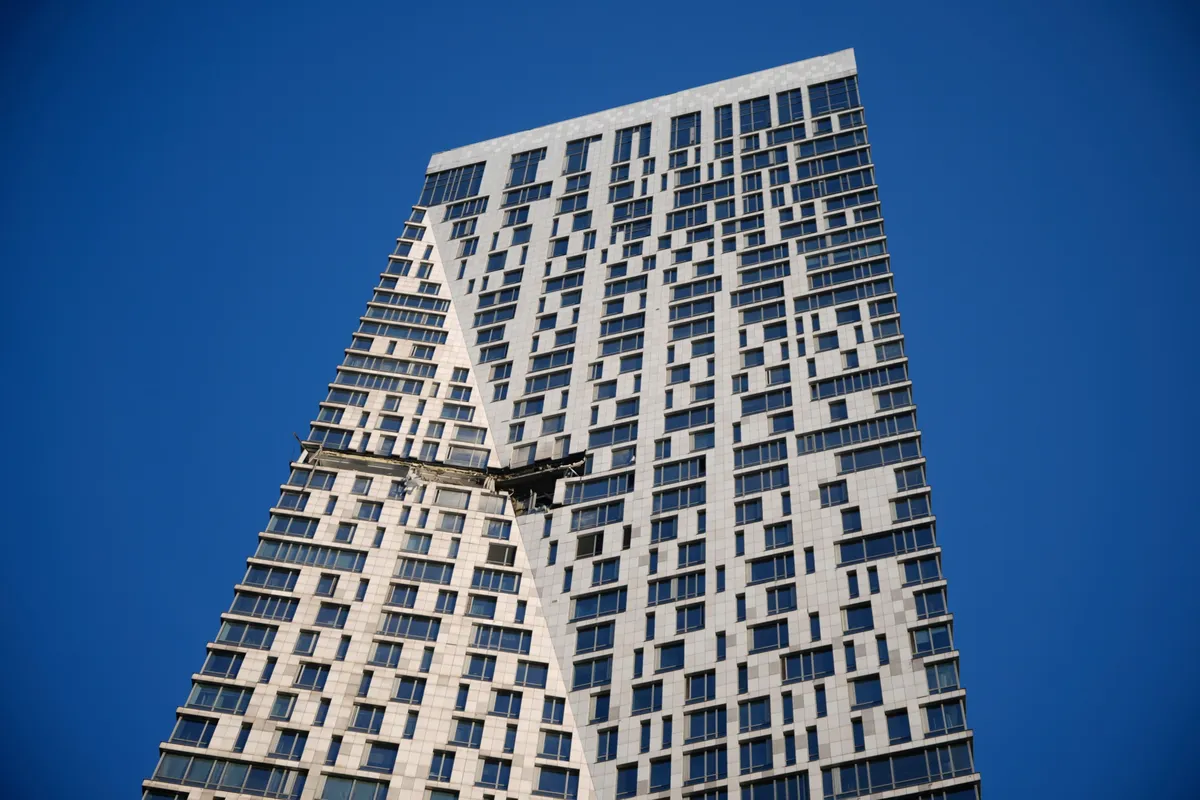
According to Moscow Mayor Sergei Sobyanin, air defenses repelled an attack by two Ukrainian drones, but one of them struck a building on Mosfilmovskaya Street. Emergency services arrived at the scene. There were no immediate reports of casualties.
Mosfilmovskaya Street is located roughly six to eight kilometers from the Kremlin. For Moscow, this is an unusually close distance: drone attacks inside the capital remain rare, especially when they involve expensive residential areas near the city center. Local media showed damage to the upper floors of the high-rise residential complex.
Moscow Prepares for May 9 Amid Heightened Anxiety
The incident occurred as the Russian capital prepares for the traditional May 9 parade marking the Soviet Union’s victory over Nazi Germany in World War II. For the Kremlin, the ceremony has long been not only a commemorative event but also an important political display — a symbol of state strength, historical continuity and control over the situation.
This year, however, preparations for the parade are taking place against the backdrop of noticeably increased security threats. Russia’s Defense Ministry had earlier announced that, for the first time since 2007, the parade would be held without heavy military equipment. The Kremlin explained the decision by citing possible risks and the need to take potential threats into account.
Against this backdrop, the drone strike on a residential high-rise near central Moscow appears especially sensitive. Even if the physical damage was limited, the fact of an attack near one of the country’s most protected areas calls into question the sense of complete security that the authorities traditionally seek to project during major state events.
President Vladimir Putin is expected to deliver a speech at the parade. Among the foreign guests this year, according to the Kremlin, will be Slovak Prime Minister Robert Fico.
Ukraine Expands the Geography of Strikes Inside Russia
In recent months, Ukraine has stepped up attacks on Russian territory, including strikes on energy infrastructure. Increasingly, the targets are not only border regions but also areas located much farther from the front line.
According to Bloomberg, Ukraine has begun regularly striking targets deep inside Russia. Last week, attacks were reported even in the Urals — around 1,700 kilometers from the Ukrainian border. This shows that the war is increasingly moving beyond its familiar front-line geography and affecting regions that until recently were seen as far removed from any direct threat.
A strike on Moscow carries particular significance in this context. The capital remains Russia’s main political and symbolic center, which means any attacks within its boundaries are perceived far more sharply than similar incidents in less prominent regions. Even limited damage can produce a broad psychological effect.
Internet Restrictions Do Not Guarantee Security
Russian authorities have already responded to the drone threat with various security measures. Among them are temporary shutdowns of mobile internet, and sometimes even fixed-line connections, in certain cities. Such decisions are officially explained by the need to complicate drone navigation and reduce the risk of attacks.
However, the drone hit on the building on Mosfilmovskaya Street once again raises questions about the effectiveness of such measures. If, even under tighter controls, a drone can reach an area just a few kilometers from the Kremlin, citizens will inevitably wonder whether communication restrictions truly improve security or mainly complicate everyday life.
For residents of major cities, internet shutdowns are not an abstract wartime measure. They affect work, payments, transport, communication with relatives and access to information. As a result, such restrictions are causing growing irritation, especially when they are not accompanied by a clear sense of greater protection.
Bloomberg notes that public discontent over tightening internet restrictions has already become a noticeable source of pressure on the Russian authorities. Against this backdrop, the latest strike on Moscow may intensify a question that is becoming increasingly difficult to ignore: how effective are the measures that officials present as a response to the drone threat?
A Symbolic Strike Ahead of a Key State Holiday
The drone hit on the residential high-rise on Mosfilmovskaya Street came on the eve of one of the most important dates in Russia’s political calendar. The Victory Day parade remains a central ritual for the Kremlin, through which the authorities speak about the country’s past, present and future.
That is why the incident proved especially notable. It happened not in a remote region and not at an industrial facility, but in an upscale district of the capital, close to the center and just ahead of an event meant to demonstrate the state’s confidence.
This time, according to preliminary reports, there were no casualties. But the political and psychological significance of the strike may be greater than the immediate damage. Moscow is preparing for a parade intended to project resilience and strength — yet the capital itself is increasingly encountering signs of a war that the authorities long tried to keep at a distance.
This article was prepared based on materials published by Bloomberg. The author does not claim authorship of the original text but presents their interpretation of the content for informational purposes.
The original article can be found at the following link: Bloomberg.
All rights to the original text belong to Bloomberg.