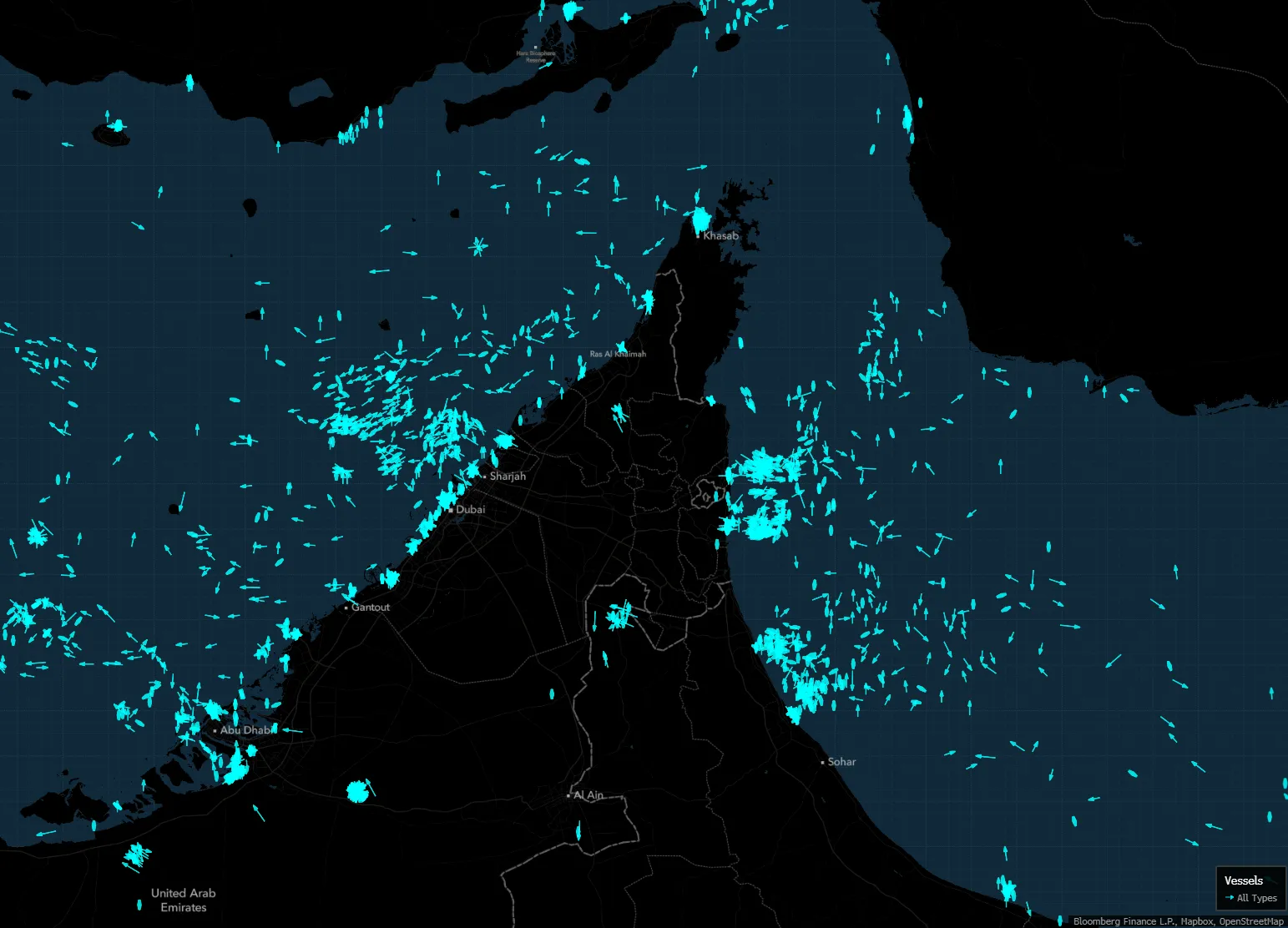
Amid rising tensions around the Persian Gulf and the Strait of Hormuz, signs of large-scale disruption to vessel navigation signals have reappeared in the region. According to Bloomberg, dozens of ships in tracking systems suddenly began appearing not at sea, but on land — deep inside the territory of the United Arab Emirates and near the border with Oman.
This is not a case of vessels actually moving onto land, but most likely a distortion in geolocation data. Around 120 ships, according to tracking services, were shown clustered in a circle roughly an hour’s drive from Abu Dhabi. At the same time, the systems indicated that they were moving at nearly 50 knots without changing their coordinates. Another, smaller group — about a dozen vessels — appeared near the land border between Oman and the UAE at speeds of more than 100 knots, which is physically implausible for ordinary commercial shipping.
Electronic warfare spills over into commercial shipping
Analysts believe such anomalies may be the result of the jamming or spoofing of navigation signals. The disruptions came after the UAE said it had activated air defense systems to intercept missiles and drones launched by Iran. Bloomberg notes that this was Tehran’s first attack on the country in almost a month.
Mark Douglas, an analyst at Starboard Maritime Intelligence, said that after the latest strikes, Gulf states, including the UAE, may have activated electronic warfare systems. As a result, not only military infrastructure but also civilian shipping may have been affected.
“Shipping, and most noticeably AIS data, got caught in the crossfire,” Douglas said, referring to the Automatic Identification System used by vessels to transmit their coordinates, course and speed in real time.
Why it matters for the oil market
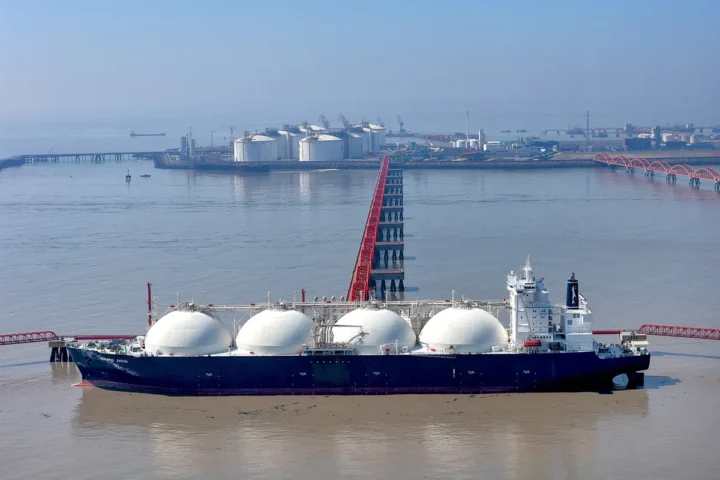
The problem goes far beyond a technical glitch. The Strait of Hormuz remains one of the world’s key energy arteries: major volumes of oil and liquefied natural gas from Gulf states pass through it. Any distortion in data on tanker movements makes it harder to assess real supply flows, routes and risks for the market.
According to Bloomberg, the current level of electronic interference has not yet reached the scale seen at the start of the conflict. However, the appearance of “clusters” of ships on land points to a renewed rise in activity after a period in which such disruptions had eased.
The situation is further complicated by the fact that some captains are already using additional security measures, including switching off transponders. This may reduce the risk of being detected by hostile forces, but it also makes the picture of maritime traffic less transparent for analysts, insurers and energy companies.
Hormuz is almost at a standstill
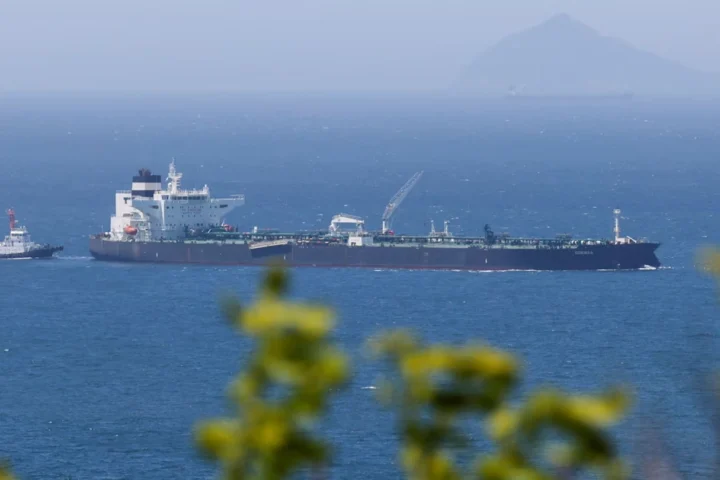
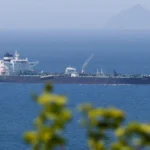
Against this backdrop, traffic through the Strait of Hormuz remained almost paralyzed on Monday, according to Bloomberg. Only two tankers made rare crossings and emerged into the Gulf of Oman.
One of them was the Agios Fanourios I — a very large crude carrier loaded with Iraqi oil. Its shipping data listed Vietnam as its destination.
For the market, this is another warning signal: even if the strait is not formally closed, the combination of military threats, attacks on vessels and navigation interference is making passage through one of the world’s most important maritime corridors increasingly risky. In these conditions, every disruption in tracking systems becomes not just a technical anomaly, but part of a broader picture of instability in a region on which a significant share of global energy flows depends.
This article was prepared based on materials published by Bloomberg. The author does not claim authorship of the original text but presents their interpretation of the content for informational purposes.
The original article can be found at the following link: Bloomberg.
All rights to the original text belong to Bloomberg.