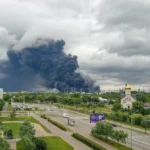
Russia is beginning to transfer part of the responsibility for protecting industrial facilities and critical infrastructure to companies themselves. According to Bloomberg, the move comes as Ukraine has significantly intensified drone strikes this year against factories, ports, oil refineries and other facilities important to the Russian economy.
The new arrangement would allow Russia’s Defense Ministry to permit businesses to purchase large-caliber air-defense systems. At the same time, according to the agency’s sources, the systems would remain under the control of the military, while reservist units would operate them. In other words, companies would be able to finance additional protection for their facilities, but they would not gain full independent control over such weapons.
The equipment under discussion may include not only anti-aircraft mounts, but also radar systems, electronic warfare equipment, air-defense artillery systems and other elements designed to counter aerial targets. Russia’s RBC news outlet previously reported that such a range of weapons and equipment was being discussed within the Defense Ministry.
Strikes on Refineries Force a Rethink of Infrastructure Protection
The reason for these decisions is the sharp expansion of Ukrainian attacks on Russian energy and commodities infrastructure. In recent months, some of the country’s largest oil refineries have come under attack. According to Bloomberg, drones targeted eight of Russia’s ten largest refineries last month, pushing daily crude processing to its lowest level since October 2009. This, in turn, increased the risk of domestic fuel shortages just as summer travel demand was rising. Fertilizer production has also been disrupted.
Ukraine has also extended the range of its strikes inside Russian territory. Targets are increasingly located not only in border regions, but also deep inside the country — as far as the Urals, roughly 2,000 kilometers from the border. Against this backdrop, President Vladimir Putin has called for stronger air defenses.
Large commodities and industrial companies within range of Ukrainian drones have already begun looking for ways to protect their facilities. Some of them, according to Bloomberg’s sources in the industrial sector, have reached agreements with the Defense Ministry to deploy Pantsir missile-and-gun air-defense systems near their plants. Until recently, however, air defense was not a service that businesses could simply pay for in the same way they pay for electricity, water or private security.
The State Keeps Control, but Business Will Have to Pay
The situation is now changing. On May 26, Alexander Shokhin, head of the Russian Union of Industrialists and Entrepreneurs, told Vladimir Putin that companies wanted access to defensive equipment — from small arms to larger-caliber systems, as well as electronic warfare and laser technologies. According to him, businesses are ready to finance such measures themselves.
In effect, this points to a new model for distributing military costs inside Russia. The state retains control over the weapons and their use, but part of the financial burden of protecting industrial assets may fall on private and state-owned companies. For businesses, this means additional costs; for the authorities, it offers a way to expand the protective perimeter around facilities that are becoming increasingly vulnerable to long-range Ukrainian drones.
The scheme also shows how serious the problem of strikes on Russian infrastructure has become. Whereas drone attacks were previously seen mainly as a military or border-area threat, they now directly affect oil refining, export logistics, fertilizer production and the domestic fuel market. As a result, the Kremlin is trying to integrate business into the defense system not only as a taxpayer or supplier of resources, but also as a direct participant in financing the protection of its own assets.
This article was prepared based on materials published by Bloomberg. The author does not claim authorship of the original text but presents their interpretation of the content for informational purposes.
The original article can be found at the following link: Bloomberg.
All rights to the original text belong to Bloomberg.